
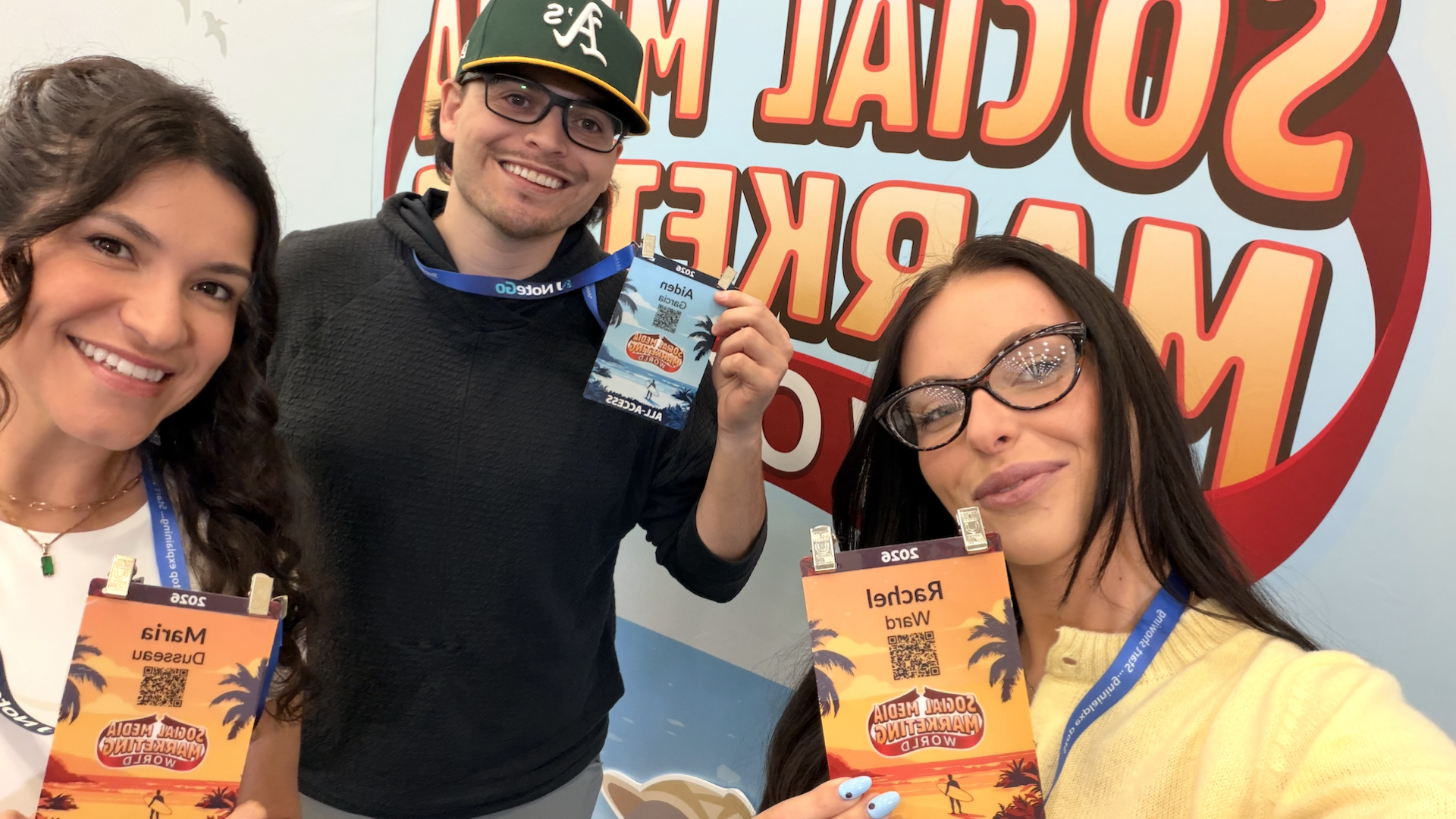

The social team had the opportunity to attend the Social Media Marketing World conference for the second year in a row. We came back from Anaheim with full notebooks and one very clear realization: the way most of us have been working doesn’t hold up anymore. The tools have changed, but the actual rules of online growth have shifted even more. The gap between the marketers who get it and those who don’t is widening fast.
Across sessions, every speaker kept circling back to the same idea of looking at things from multiple angles. The edge is no longer in having access to platforms, tools, or even great content. Real success comes from depth of community, workflow, and systems, which compounds quietly while everyone else is still chasing reach.
In the instance of Meta, the message was blunt: the old playbook is dead. The algorithm has moved from showing your content to your followers to presenting it based on interest signals. Now it is heading toward an intent graph that predicts purchase behavior before users even know what they want. Viral reach doesn’t equal revenue anymore, and with 90% of online content predicted to be AI-generated by 2027, content itself is becoming a commodity. The only obstacle left is a real community that actually knows and trusts you. The tactical stuff matters too. Never put links in the body of a post (put them in the first comment only) and respond to comments within the first hour. If you run a Facebook Group, collect emails at the point of join; your email list is the only audience you actually own.
YouTube told a similar story about depth over volume. Seventy percent of YouTube users have purchased a product after discovering it on the platform. The average session time is close to an hour, and the content is evergreen. A video you make today can easily generate revenue for years. The framework that stuck with us is clear. A third of your content should focus on discovery, half on trust-building tutorials, and the rest on lead generation. Most creators get this backwards. They turn every video into a pitch, and YouTube suppresses them for it. The real unlock isn’t scale, it is alignment. One creator built $100K in monthly revenue just by auditing their analytics. They realized their actual audience of 55+ males wanting to relocate was completely different from who they thought they were targeting. The offer pivot did the rest.
The AI tools session with Dan Sanchez reframed how we think about the whole category. His argument: most marketers are using AI like a search engine. One prompt, one output, done. The real leverage is in chaining tools into compounding workflows. He actually cut his own stack from 25 tools down to 15 this year. The best tools aren’t flashy, they just feed into each other. He calls this building a Context Stack. First, run deep research on your audience’s pain points and save the outputs. Then, feed those documents into your AI tools to give context to every single content task. The result is copy that sounds like your customer because it’s built from their actual language. The number one skill to learn right now is how to use agentic tools like Claude Code and custom GPTs. These don’t just answer your questions, they actually do the work across your systems.
The most powerful talk was the closing keynote by Dr. Nici Sweaney. She shared that fewer than 1% of professionals actually use AI as an operating system. Her own business runs at multi-seven figures on a four-day week. The team is composed of three part-time humans and roughly 41 AI agents, handling everything from marketing to legal to strategy. She contrasted acceleration – doing the same work faster – with transformation, completely rethinking how the work gets done. Most teams are still at Level 1 which is opening ChatGPT, copying and pasting the output. The goal she set for the room was just to reach Level 2 by the end of the week, which is to write one Skills file. Pick your most painful recurring task, ask an AI to interview you about it, and save the output as a Markdown doc. That file becomes a portable asset that works across every platform and seeds every future agent you build. She also made a crucial point most AI sessions skip. Without explicit guardrails for your brand values, AI agents will just default to whatever the internet normalizes. Every organization needs a written AI code of conduct, even though most don’t have one.
The recurring theme across every session at SMMW 2026 was clear: the era of chasing broad reach is being replaced by a critical need for depth and true community. As content becomes cheap and generic, your only true defense is the trust you build with your audience. Simultaneously, the way we work must evolve from using AI as a simple search engine to building compounding systems that transform our productivity. The playbook is rewriting itself in real time, and the only way to survive the shift is to adapt how you work before the market decides for you.


